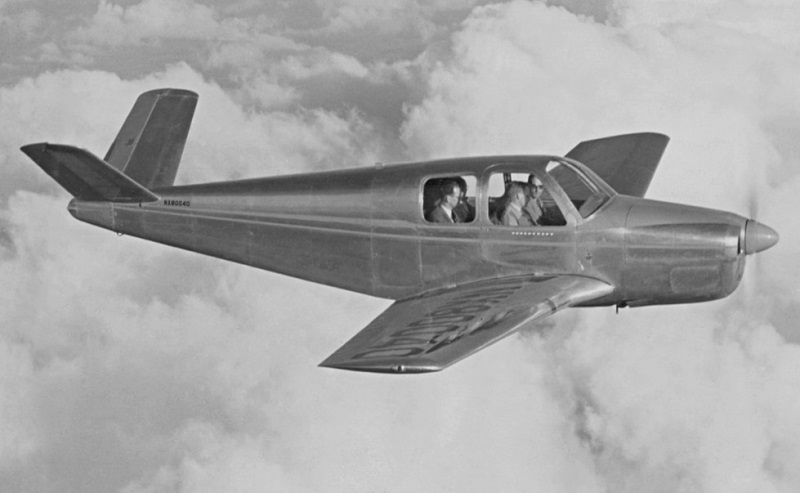
1st Generation Bonanzas… were built from 1947 to 1956.
Engines offered were the Continental E Series 470 cid, dry sump, six cylinder rated at 165hp, 185hp, 196hp, 205hp, and 225hp.
V-Tail Changes…in 1951, starting with C35 the dihedral of the V tail was changed from 30 degree to 33 degrees. The chord of the V tail was increased from 42 inches at the root to 50.5 inches. This was the standard V tail configuration from 1951 till end of production in 1984.
Common Mods…Speed Slope windshield, baggage compartment aux fuel tanks of 10 or 20 gallons, electric auxiliary fuel pump instead of manual “wobble” pump, M wing tips, tip tanks, third windows, engine upgrades, hydraulic prop, adjustable front seat tracks, aluminum flaps and ailerons. Many first gen Bo’s have a variety of engine mods from E-series higher horsepower engines to late model Continental 0-550’s…with 0-470’s and 0-520’s in between.
What Makes Them Special…1st generation Bonanzas are very light on the controls in all three axis. All three axis are very balanced. They are flown by the finger tips. Have excellent power to weight ratios rivaling the later model heavier 3rd generation 285-300hp versions. 850-1,000lb useful loads depending on mods. Max gross weight of the 1st generation Bonanzas are 2725 lbs vs 3400 lbs for the third and last generation V-tails.
Common Misconceptions…unstable with “the Bonanza Boogie”, weak air-frames, hard to start, not good instrument platforms. We will address these common misconceptions in a separate page on this website.
Electric Prop…The Beech 215 electric prop has never had an AD against it. Very durable if maintained properly. Much slower reacting than a hydraulic controlled prop.
What is a Pressure Carburetor?…A pressure carburetor is much like an early single point, or throttle body fuel injection set up. It does not have a float. It is much more resistant to carburetor icing than a standard updraft, float equipped aircraft carburetors. Much more fuel efficient as well.
Flying a 1st Generation Bonanza safely requires careful speed control. It has a an overall drag coefficient of 0.0049, cleaner than a P-38 at 0.0054, and almost as clean as a Learjet 25 at 0.0042. This means a first generation Bonanza can cruise at 75% power well into the yellow arc. They take careful planning to get slowed down for pattern entry and not exceed gear and flap extension speeds. Letting the nose drop at cruise speeds can lead to exceeding the 204mph VNE very quickly. Early test flights demonstrated that it took only 6 seconds to accelerate from the 204 mph VNE to 286 mph in a 30 degree dive.
With the 88 inch prop on some 185/205/225hp E-Series engines, there is a lot more torque and P factor corrections required when taking off than many pilots are used to.
Direct crosswinds from the left in excess of 12-15kts can require right rudder inputs exceeding the airplane’s limits to track straight. Direct crosswinds from the right at 20kts+ can be relatively easy to handle with plenty of rudder authority available.

 Holdeman Aero